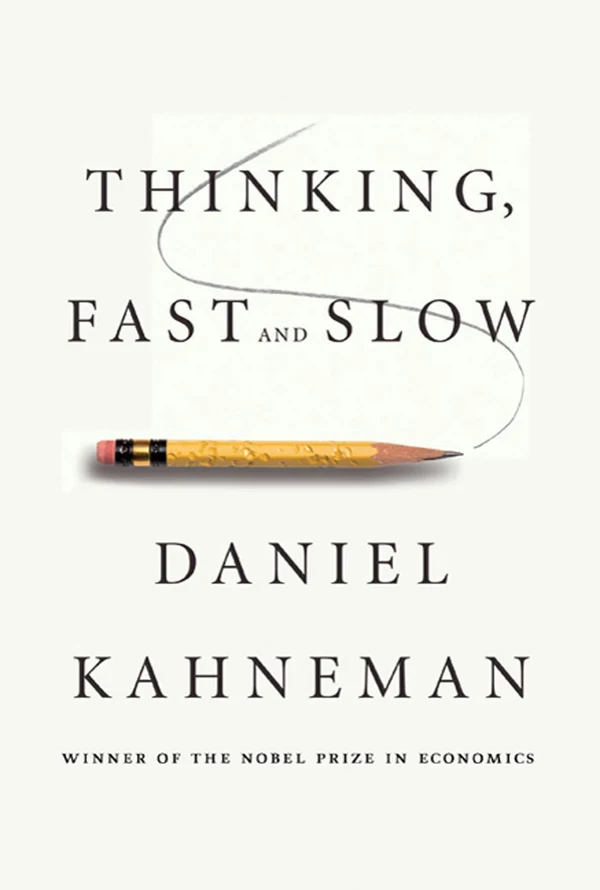
A demanding and valuable examination of how confidence, intuition, and the framing of a question influence what we decide.
The review
Kahneman explores the interaction between quick, intuitive judgment and more deliberate reasoning. Drawing on his work in psychology and decision-making, he shows how apparently straightforward choices can be shaped by context, readily available information, and the way an option is presented. The book is especially useful when it makes a reader less certain that feeling convinced is the same as having examined the evidence.
The business value lies in improving the conditions around a decision, not merely instructing everyone to think harder. A confident opening estimate can shape the entire discussion; a vivid recent event can overshadow a wider pattern. Leaders can respond by gathering independent judgments, comparing relevant examples, and stating what would change their minds. The aim is to make a decision easier to examine before the outcome is known.
Consider an illustrative project estimate discussed after a senior leader announces an ambitious delivery date. Colleagues may adjust their figures toward that date without recognizing how much it has influenced them. Asking for independent estimates first, then comparing assumptions, exposes the disagreement earlier. At home, the same question applies when an advertised discount becomes the reference point for a purchase: would the offer still look attractive without the original number beside it?
This is a book to work through thoughtfully rather than a list of tricks for diagnosing other people’s mistakes. Its framework helps describe judgment, but naming a bias does not prove that it explains a particular decision. Nor is slow deliberation automatically superior in every situation. The most productive reading combines intellectual humility with a small change to an actual decision process, then checks whether the change helps.
The following are our practical applications of the book’s ideas. Choose one action to try this week, then reflect on what changed.
IDEAS INTO ACTION · AT WORK
Three things to take to work
Gather independent views before discussion
Ask colleagues to record an estimate and its assumptions before hearing the most senior person’s view. Compare the differences first, so the meeting does not simply converge around the opening number.
Look beyond the most memorable example
When evaluating a proposal, compare it with several genuinely similar situations. Ask whether a striking recent success or failure is receiving more weight than the broader evidence supports.
Record what would change your mind
Before committing to an option, write down the evidence that supports it and the result that would lead you to reconsider. Review that record later rather than reconstructing the reasoning from memory.
BEYOND THE WORKING DAY
Three things to take into life
Reframe an attractive offer
Describe a purchase without its discount, countdown, or comparison price. Ask whether the item still serves a real priority when those presentation cues are removed.
Pause when certainty arrives unusually quickly
For a consequential choice, identify what you know directly and what you are inferring. Seek one useful piece of missing information before treating a coherent first impression as a complete account.
Question your own explanation first
When a disagreement seems easy to explain as someone else’s poor judgment, describe the information they may be using. Apply the same curiosity to your own assumptions before attaching a label.
A question for your team
Which part of your decision process makes it easiest for a confident first opinion to become an unquestioned assumption?
FROM READING TO PRACTICE
How Genellipse can help
Genellipse can help partners make the evidence behind business and AI decisions easier to inspect. GeneData and GeneAnalytics can support shared definitions and traceable measures, while our consulting services structure independent evaluations and review points. For an AI-enabled workflow, we can agree acceptance criteria before testing so that an impressive demonstration is assessed against the actual business need.
Explore the related serviceThese reviews were prepared retrospectively in September 2026. Month labels organize the reading series and are not original publication dates. Personal ratings are provided by Abdollah Dehnashi; the reviews and practical applications are prepared for CEO Corner.