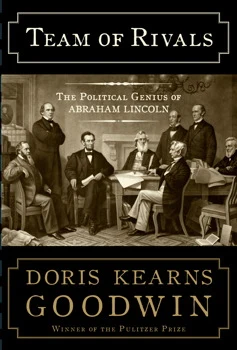
A substantial study of leadership through disagreement, showing why a strong team needs more than people who already share the leader’s view.
The review
Goodwin examines Abraham Lincoln’s political leadership through his relationships with prominent rivals and the cabinet he assembled during the Civil War. The historical narrative follows competing ambitions, strong personalities, and the work of holding a government together amid profound conflict. Its interest extends beyond the familiar idea of hiring talented people: it asks how a leader draws on that talent when agreement and loyalty cannot simply be assumed.
For an enterprise reader, the useful connection is the distinction between including different perspectives and allowing those perspectives to influence a decision. A leadership team can appear diverse in expertise while rewarding only agreement. Meaningful inclusion requires an important problem to solve together, clarity about who decides, and enough trust that disagreement does not become personal exclusion. The historical stakes remain distinct from an ordinary management challenge.
Imagine an illustrative modernization programme in which operations wants stability, technology wants architectural change, and finance wants an earlier return. Treating one position as an obstacle loses information about the whole problem. Asking each group to explain its strongest concern, then defining a shared outcome and a decision owner, makes the disagreement more useful. The same practice can improve a family or community discussion where people agree on the purpose but differ about the route.
The book rewards attention to historical detail and the relationships that develop over time. It should not be reduced to a universal claim that rivalry produces better teams or that every disagreement can be reconciled through personality. Its most useful leadership question is more disciplined: what would enable capable people with different interests to contribute honestly to a common responsibility?
The following are our practical applications of the book’s ideas. Choose one action to try this week, then reflect on what changed.
IDEAS INTO ACTION · AT WORK
Three things to take to work
Invite the strongest competing argument
Before deciding, ask the person with the most relevant disagreement to explain their position fully. Check that the group can restate it fairly before moving to a preferred option.
Define the common outcome and the decision owner
Give a cross-functional team one shared result to pursue and clarify who resolves a remaining disagreement. This keeps different perspectives useful without leaving accountability ambiguous.
Recognize contribution without requiring agreement
Credit someone whose challenge improves a proposal even when their preferred option is not selected. Explain what changed because of their input so participation has visible value.
BEYOND THE WORKING DAY
Three things to take into life
Find the purpose beneath different preferences
In a shared decision, ask what each person is trying to protect or achieve. A common purpose may become clearer once the conversation moves beyond competing solutions.
Let another person finish the strongest version of their view
Listen long enough to explain the other person’s reasoning in terms they recognize. Understanding a position makes a response more constructive, even when the disagreement remains.
Share credit for a collective result
When a family or community effort goes well, acknowledge the different contributions that made it possible. Notice the quieter work as well as the person who presented the final outcome.
A question for your team
Whose informed disagreement is missing from your current transformation decisions, and what would make it possible for them to contribute?
FROM READING TO PRACTICE
How Genellipse can help
Genellipse can facilitate joint discovery across business, technology, actuarial, risk, and operational teams. We help partners agree shared outcomes, surface competing requirements, and define decision rights before delivery. That alignment carries into a focused MVP, where each group can assess the evidence against agreed acceptance criteria rather than separate assumptions about success.
Explore the related serviceThese reviews were prepared retrospectively in September 2026. Month labels organize the reading series and are not original publication dates. Personal ratings are provided by Abdollah Dehnashi; the reviews and practical applications are prepared for CEO Corner.