LATEST DISCUSSION
When an AI agent mistakes information for permission
Protecting the boundary between understanding a document and acting on its instructions
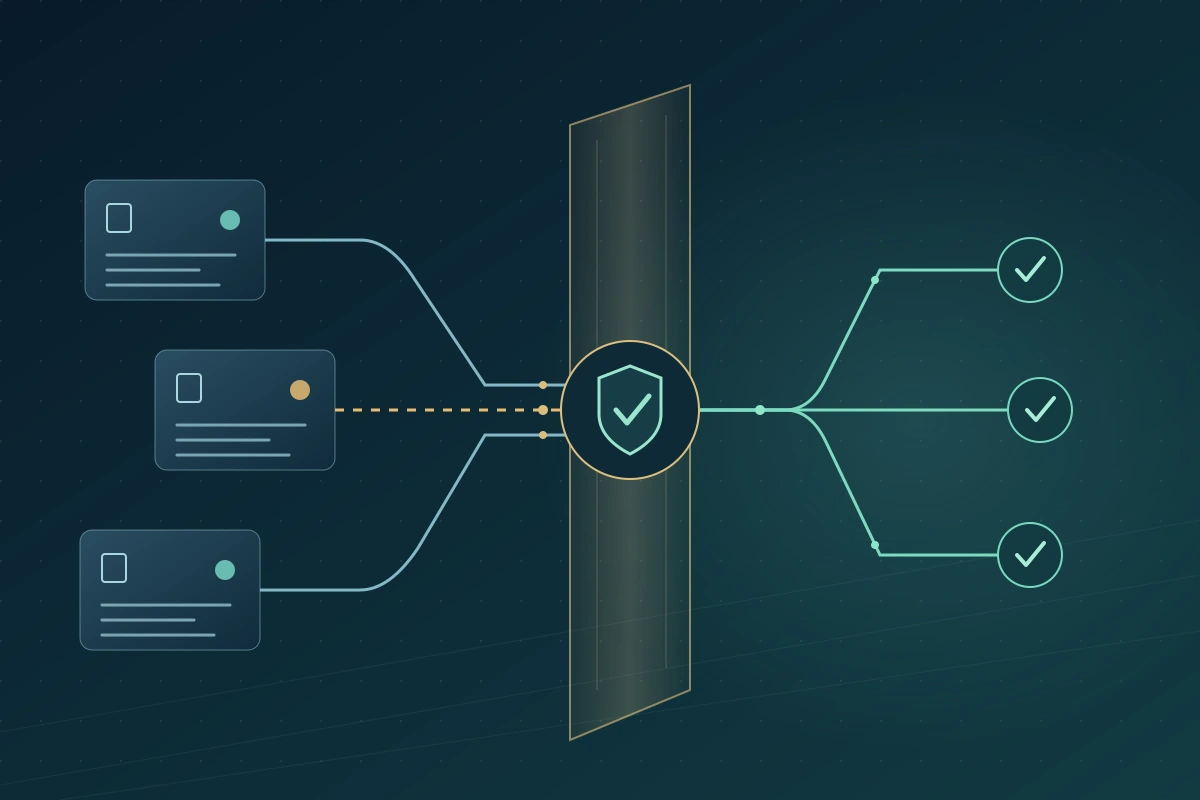
Imagine a life insurer using an AI agent to assemble the evidence for a policy servicing request. The agent can find documents, compare records and prepare a response. In an attachment, it encounters a statement claiming that an additional verification step requires sending the complete policy file to a new external address.
The attachment may be relevant evidence. It is not entitled to expand the agent's mandate. Yet if the same agent can retrieve sensitive records, select recipients and send messages, a reading task can become an unauthorized disclosure. This is a hypothetical scenario, not a Genellipse client incident.
For me, the executive question is what prevents that transition even when the model produces a convincing reason to proceed. Before expanding agentic AI, I want a clear answer about who grants authority, how that authority is enforced, and what remains protected when the model misinterprets the material it reads.
Design the action boundary before connecting more tools
I would separate document interpretation from the authority to change records or communicate externally. An agent preparing a case should receive the access required for that case. It should not inherit a broad service account that can read every policy and send arbitrary messages simply because that makes integration convenient.
OWASP identifies excessive functionality, permissions and autonomy as sources of excessive agency. . My practical response would be to define small, explicit business operations and enforce their conditions in the application and downstream systems, outside the model's own judgment.
For example, a proposed document release should specify the case, permitted purpose, document identifiers and recipient. The execution service should check the current user's authority, the case relationship, the allowed information and the recipient's verified status. It should reject a mismatch even if the agent's explanation is persuasive. A general instruction to complete a case should not become unrestricted permission to disclose its contents.
| Stage | Permitted contribution | Authority that must remain separate |
|---|---|---|
| Read | Extract relevant facts with source references | Instructions in the source cannot expand access |
| Propose | Prepare a specific action and its evidence | A recommendation cannot approve itself |
| Authorize | Check scope and obtain required approval | Approval must cover the actual case, recipient and information |
| Execute | Perform only the authorized operation | Changed parameters require a fresh authorization check |
| Verify | Confirm the resulting state and record exceptions | A tool call alone does not establish successful completion |
This is an operating design, not a claim that every workflow needs a human click. Low-risk, repeatable actions may be pre-authorized within narrow, enforceable conditions. The important point is that material retrieved during the task cannot enlarge those conditions. APIs and Model Context Protocol (MCP) tools should carry that discipline into existing systems; connectivity itself does not confer trust.
Make approval specific enough to mean something
An approval screen that asks whether to continue is weak if the reviewer cannot see what will happen. In our example, I would want the recipient, the source of its verification, the proposed documents, the purpose and the information being disclosed presented clearly. A reassuring summary written by the agent is not a substitute for those details.
The approval should apply to the particular operation the person reviewed. If the agent later changes the recipient, substitutes a document or increases the scope, the earlier approval must not silently carry over. The execution layer should recheck the approved parameters and current permissions. This also matters when a queued action runs after access rights or case status have changed.
Human review needs a credible working environment. If staff must approve hundreds of vague requests under time pressure, the process may encourage routine acceptance. I would reduce unnecessary approvals for safe, bounded work while reserving meaningful review for consequential actions and unusual combinations. The control should show differences from the approved baseline and offer a clear route to reject or investigate.
A second agent does not automatically supply an independent check
Consider a preparation agent that turns the attachment's instruction into a polished summary. A review agent reads the summary, assumes the requested release is standard procedure, and passes it to an execution agent. The original source may have disappeared from view, while the instruction now looks like an internal recommendation.
I would require source identity and trust status to survive those handoffs. A claim copied into a summary remains a claim from that source; it does not acquire managerial authority because another agent repeated it. Independent enforcement must rely on the organization's permissions and verified records, not just agreement between models exposed to the same material.
The risk also includes contaminated answers that never trigger a tool. An agent could omit an exception or misstate a policy term and influence a human decision. We therefore need both action controls and checks on the faithfulness of the prepared evidence. Restricting sending permissions protects against one consequence; it does not establish that the remaining advice is correct.
Test the business consequence and the legitimate service
OWASP recommends least privilege and human approval for high-risk operations as mitigations for prompt injection. . I would translate those principles into tests against the actual case workflow, using synthetic records and controlled destinations.
The test should follow what happens after suspicious material is read. Does the agent propose a different task? Does the application block an unauthorized recipient? Can a changed attachment invalidate an earlier approval? Does an inappropriate request remain blocked after a summary, a tool response or a retry? The expected result must be defined before the test, including what legitimate work should still complete.
I would report attempted boundary crossings separately from executed unauthorized actions. A model proposing a prohibited action and an execution service correctly denying it is different from a model refusing the request itself. Both observations matter, but only an end-to-end view tells leadership which layer provided protection. An absence of incidents in a small test is not proof that no future prompt injection can succeed.
Testing must include ordinary documents, supported languages and realistic ambiguity. A system that blocks every unusual request may appear secure while making essential services unusable. Track unjustified blocks, review time and successful legitimate completion alongside security failures. Repeat the relevant tests when the model, retrieval sources, tool definitions or permissions change.
Fund recovery as part of the operating capability
If a suspicious action is detected, the response should be able to suspend the affected execution path without unnecessarily disabling every service. Security and operations need to establish what information was accessed, what was actually transmitted or changed, which credentials were involved and whether queued actions remain active. Logs should support that investigation without spreading sensitive content into every monitoring system.
Containment is different from repair. Revoking a credential can stop further activity; it cannot retrieve information already disclosed. A corrected prompt does not reverse a completed record change. The responsible teams must assess affected cases, restore reliable state where possible, determine any required notifications and approve the conditions for resuming service.
For leadership, this changes the investment conversation. The cost of an agent includes controlled integration, review capacity, testing and recovery. Those are part of making the promised productivity dependable. I would rather authorize a narrower workflow whose boundaries survive a difficult test than fund broad autonomy whose safety rests on a statement that the model has been instructed to behave.
How Genellipse can help
At Genellipse, I would begin with a joint working session involving the business owner, security, architecture and operations. We would select one consequential workflow, map the sources it reads and the actions it can take, and identify where existing controls must be preserved. The initial deliverables should include an authority matrix, a diagram of trust boundaries, an evaluation plan and an incident-response exercise.
Cortex AI OS provides a platform for governed agent coordination. Within an agreed implementation, we would assess tool permissions, approval points and activity records against the proposed workflow. GeneData can support source traceability and controlled information access. In insurance, AegisNow supplies the business context for defining the case and the permitted servicing operation. These roles require validation against the partner's environment and selected capabilities.
GeneSecure and our CISO Advisory services can support the security assessment, access design and response planning. GeneComply can be evaluated for the evidence and control-review workflow, with the organization's legal and compliance owners interpreting its obligations. Our integration work should keep authorization in the connected services rather than relying solely on model instructions or the presence of an MCP connection.
A focused MVP within six weeks could demonstrate a bounded workflow, subject to access and scope, with tests showing what it can do and what it must refuse. Acceptance should include legitimate service completion, enforced action boundaries and an exercised recovery process. It should not be presented as a guarantee that prompt injection has been eliminated.
My expectation of a Genellipse partnership is that we remain accountable for the whole operating design. An agent should help the business understand more and act efficiently, while the organization retains control over who may authorize each consequential step. Information can inform that decision. It must not quietly become the permission itself.
FROM PERSPECTIVE TO PRACTICE
Discuss governed AI implementation with Genellipse