
آخر المناقشة
عندما ينقل الذكاء الاصطناعي عنق الزجاجة إلى فريق الخبراء
لماذا يجب أن يراعي الاستثمار المؤسسي في الذكاء الاصطناعي ندرة الخبرات وترابط القرارات وتكلفة العمل غير المكتمل
The investment case looks persuasive. An insurer can assemble policy records faster, prepare correspondence in minutes and resolve more routine requests without repeated manual handling. Its AI service has passed the agreed technical evaluation. The next proposal is to extend it across two acquired portfolios.
Before approving that expansion, I would ask a different question: has the organization increased its ability to reach an accountable decision, or only its ability to prepare work for one? The difference matters when automation scales across businesses whose contracts, records and authorities have not become interchangeable. A faster front end can expose an operating constraint that the original business case barely priced: access to the right expertise at the right moment.
Expertise is a constrained operating resource
An hour saved in document preparation is not automatically an hour available to interpret an inherited policy guarantee. A data engineer may repair a record without having authority to determine its contractual effect. A senior claims professional may have that authority but still need a different team to establish what actually happened. The scarce resource is qualified decision capacity attached to a particular responsibility, not a general pool of employee time.
AI can change both the volume and the composition of that demand. Better detection may send more genuine conflicts to specialists. Automating straightforward work may leave reviewers with a harder mix of cases. Extending the service to another book may introduce new exceptions, even when the interface and agent remain unchanged. Yesterday's referral percentage and average handling time are therefore assumptions to test, not constants to carry into the next investment proposal.
This is an allocation decision for leadership. Budgeting the platform while treating specialist attention as an unlimited contribution from the business understates the cost of operating it. Conversely, maintaining every existing handoff because it feels cautious can consume expertise without improving outcomes. We need to distinguish necessary judgment, missing evidence and a routine authorization that has been routed to the wrong person.
An acquired life portfolio exposes the constraint
Consider a fictional insurer integrating two acquired life-insurance books while retaining their policy administration systems. Cortex AI OS and AegisNow could be evaluated within this kind of workflow; the scenario is not a description of a deployed customer solution. The proposed service handles 6,000 requests per month, including servicing inquiries, contract questions and changes requiring particular care. All numbers below are selected illustrative inputs.
Assume four mutually exclusive case categories. A referred case can consume time in both specialist pools; those hours must be added without counting the case as two customers. The first pool handles insurance interpretation and authorized decisions. The second resolves records and data discrepancies. Available monthly time, after other duties and planned absence, is 360 and 400 hours respectively. Those pools are not assumed to be interchangeable.
| Monthly case category | Cases | Insurance specialist minutes per case | Data specialist minutes per case | Insurance hours | Data hours |
|---|---|---|---|---|---|
| Routine requests | 4,800 | 0 before quality sampling | 0 | 0 | 0 |
| Contract interpretation | 600 | 20 | 5 | 200 | 50 |
| Record discrepancies | 420 | 10 | 30 | 70 | 210 |
| Consequential changes | 180 | 45 | 15 | 135 | 45 |
| Quality review of 240 routine cases | Included in the 4,800 above | 5 per sampled case | 0 | 20 | 0 |
| Total specialist workload | 6,000 unique cases | — | — | 425 | 305 |
The sample is an assumed 5% of routine cases, not a recommended assurance rate or evidence of statistical sufficiency. It contributes 20 hours of insurance review. In practice, the sampling design should reflect consequences, case diversity and the assurance question; some decisions require individual approval regardless of sampling.
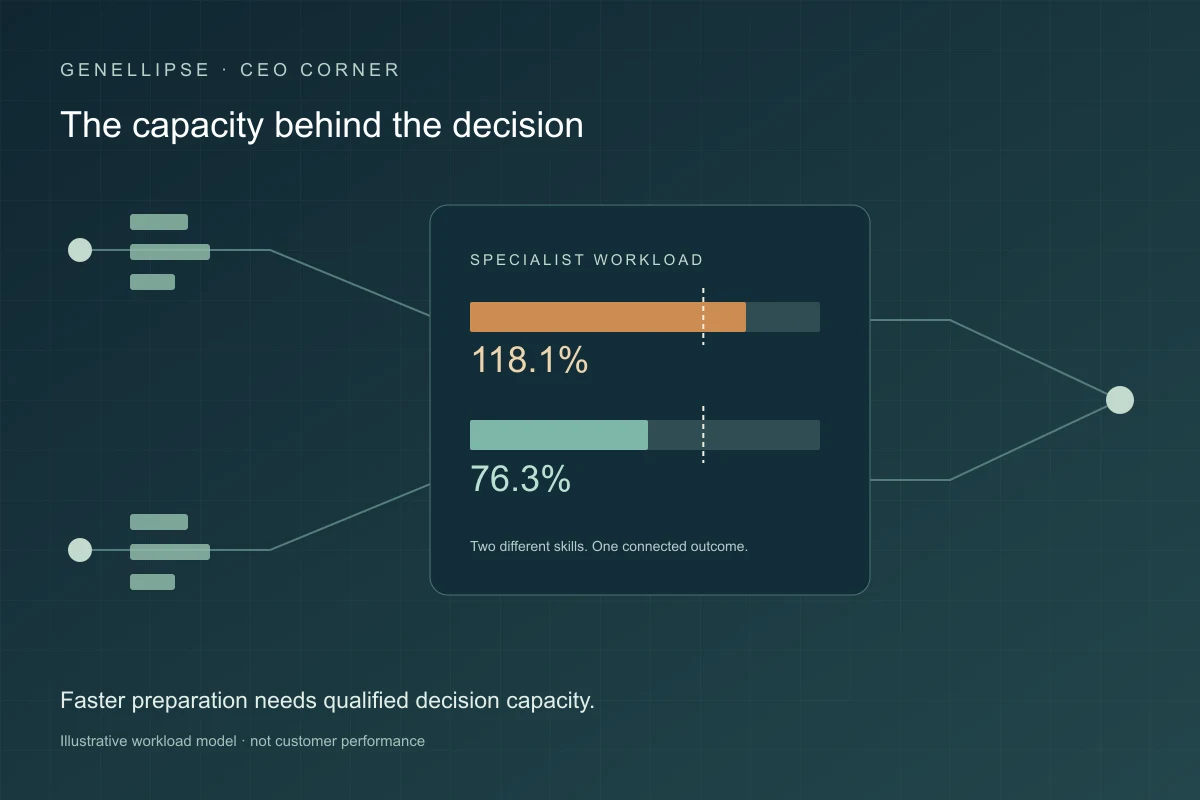
The combined workload is 730 hours against 760 available: an apparently manageable 96.1%. Yet the insurance pool needs 425 hours against 360, a 65-hour deficit and 118.1% load. The data pool has 95 unused hours, but those hours cannot authorize an insurance decision. Aggregating the two pools hides the constraint. This calculation describes workload, not waiting times or a predicted number of overdue cases; case sequence, arrival patterns and skill coverage would be needed for that analysis.
The best local improvement may leave the business problem intact
Now consider three competing proposals. The data team can reduce discrepancy work from 30 to 20 minutes per affected case, releasing 70 hours. That is useful if it improves record quality or creates usable capacity. It does not, on the stated assumptions, remove the 65-hour insurance deficit. A vendor could demonstrate a substantial improvement while the customer's decisive wait remains unresolved.
A second proposal supplies better evidence for contract interpretation and reduces insurance review from 20 to 15 minutes. It releases 50 hours, leaving demand of 375 against 360: still a 15-hour deficit, before any additional allowance for variability. The reduction needs testing on representative contracts. A shorter review caused by a more persuasive but less challengeable summary is not the same improvement.
A third proposal adds 90 genuinely available, qualified insurance hours. Capacity becomes 450 against 425, leaving 25 hours. Recruitment, training, supervision, absence and the work displaced elsewhere must be included before calling those hours available. That 25-hour difference is not proof that a service target can be met. It may be inadequate when urgent work arrives together or a particular specialist is unavailable.
| Option tested independently | Insurance demand / capacity | Data demand / capacity | What the option establishes |
|---|---|---|---|
| Current illustrative design | 425 / 360 hours | 305 / 400 hours | Insurance expertise is the constraint |
| Faster data discrepancy work | 425 / 360 hours | 235 / 400 hours | 70 data hours released; insurance deficit remains |
| Better contract evidence | 375 / 360 hours | 305 / 400 hours | Insurance deficit reduced to 15 hours |
| Add 90 qualified insurance hours | 425 / 450 hours | 305 / 400 hours | 25 insurance hours remain before variability |
The options are not necessarily alternatives. Combining evidence improvement with additional qualified cover could create more room, while correcting records might prevent future referrals. Those relationships need evidence; do not simply add every projected benefit. My preferred funding decision would identify the constraint, test the mechanism for relieving it, and establish what new constraint appears next. An improvement in one department should earn its place through its contribution to the complete service.
Insurance specialists
118.1%- Demand / capacity · hours
- 425 / 360
- Shortfall · hours
- 65
Data specialists
76.3%- Demand / capacity · hours
- 305 / 400
- Shortfall · hours
- 0
Combined picture
96.1%- Demand / capacity · hours
- 730 / 760
- Shortfall · hours
- 0
One difficult case reveals what a capacity spreadsheet omits
Imagine a bereavement case from an acquired book. The older administration system names one beneficiary, a later document appears to change that designation, and the consolidated record has not captured the relationship clearly. An agent can gather the permitted records and describe the conflict. It should not turn the most recent-looking document into an entitlement decision.
The data specialist establishes provenance, chronology and whether migration omitted relevant information. The authorized insurance professional assesses the contractual implications under the applicable rules, consulting legal or other specialists when needed. Correcting the data does not itself authorize a payment; approving a decision does not establish that a downstream system executed it correctly. Each responsibility needs its own evidence and confirmation.
Some work can proceed in parallel, but the final decision may depend on the data investigation. The case can therefore wait even when the insurance reviewer has a free slot. A useful operating design records dependencies, required skills and the next responsible owner, rather than repeatedly handing the whole file between departments. It also preserves the customer's original journey and elapsed time when an internal status changes.
This is where the architecture and the service promise meet. Every referral should identify the unresolved question, supporting evidence, permitted action, relevant deadline and receiving owner. The customer should receive an understandable account of what happens next. “Awaiting human review” is not a resolution, and no team should be rewarded for closing its task while leaving the customer without an accountable owner.
Design the response to overload before expanding
The relevant management problem is not simply to keep a queue short. Some referrals protect customers; some reveal defects; others are avoidable routing errors. Measure each separately. Review non-referred cases for missed escalation, and examine whether difficult contract families or customers needing additional support wait disproportionately. Track open-case age alongside completed-case turnaround so that unfinished work does not disappear from the reported result.
Agree in advance who can add qualified cover, repair evidence, change task allocation or pause expansion to a new cohort. A pause in rollout must preserve the service already owed to existing customers. It does not authorize suppressing valid requests, extending applicable deadlines or weakening approval requirements. Test a concentrated arrival of urgent cases and the absence of the only specialist for one contract family; a monthly aggregate cannot answer either question.
NIST's voluntary AI RMF 1.0 addresses oversight responsibilities and risk-management resources. NIST AI RMF Core. My proposed application is an operational acceptance decision alongside model acceptance: demonstrate that the receiving teams can act, challenge and recover under the conditions in which the service will run.
The FCA's UK consumer-support review emphasizes outcomes beyond transactional measures, for firms within the Consumer Duty's scope. FCA consumer-support review. In our operating review, I would connect queue measures to repeat contact, corrected decisions, unresolved exceptions and the quality of support customers actually receive.
Price the completed outcome and the unfinished obligation
The economic comparison should include the complete service: technology, integration, preparation, specialist review, quality assurance, corrections and ongoing operation. Report cash expenditure separately from released capacity. If the data team uses 70 recovered hours to repair another portfolio, that can create value without reducing payroll. If insurance capacity is borrowed from another service, the cost of that displaced work has not disappeared.
Benefits also need a time dimension. A useful comparison follows equivalent case cohorts long enough to observe reopening, correction and repeat contact. Faster completion is not an established benefit if the same work returns later under another identifier. Keep original case identity, use consistent definitions, and distinguish a change in case mix from an improvement caused by the intervention.
Unfinished work should remain visible as an operating obligation, even where it is not an accounting liability. Assign ownership, monitor age and consequences, and examine the customer impact with the appropriate specialists. Do not invent a monetary value for every delay merely to complete an ROI table. Leadership should see measured cost, evidenced benefit and unresolved risk separately, with explicit conditions for the next funding decision.
How Genellipse can help build the complete operating capability
I would start a Genellipse engagement with the acquired-book journey and the people responsible for its decisions. Our CIO advisory, architecture and transformation teams can map retained systems, decision rights, skill constraints and cross-team dependencies. The initial deliverables should be a reconciled case taxonomy, a capacity model by skill, an evidence and ownership map, and acceptance criteria that cover difficult cases as well as routine throughput.
GeneData can support governed preparation and reconciliation of case, contract and event information. GeneAnalytics can help connect workload, open-case age, repeat contact and completed outcomes. AegisNow can provide insurance workflow and policy-servicing context alongside retained administration systems. The partner must confirm authoritative records, calculation responsibilities and applicable decision rules; joining the data does not resolve their meaning automatically.
Cortex AI OS can support agent coordination, evidence preparation and human-review workflows. We would design scoped access, assignment, approval and action confirmation with the partner, using appropriate APIs or MCP tools where supported. GeneComply can support control ownership and evidence, while GeneSecure can support agreed access and security controls. Product fit, integrations and operating responsibilities must be validated for the engagement; none of these connections creates professional authority or qualified staffing by itself.
For a suitably bounded scope, we target an MVP within six weeks once access, representative data and decision-makers are available. Its evaluation should compare equivalent case types, test both specialist pools, and include a difficult contract, missing evidence, reviewer absence and an overloaded queue. A broader portfolio rollout needs its own capacity and transition plan. We should expand because the full service has demonstrated readiness, not because the easiest cases look impressive.
My ambition is for AI to make expertise more effective and more accessible. That requires a business case that recognizes where expertise is scarce, protects the quality of its application and funds the work needed to reach a trustworthy conclusion. Before approving the next expansion, I would ask the team to follow one difficult case from first contact to confirmed outcome—and show who can complete each decision when demand rises. That is where the promise of AI becomes an operating capability.
من المنظور إلى الممارسة